
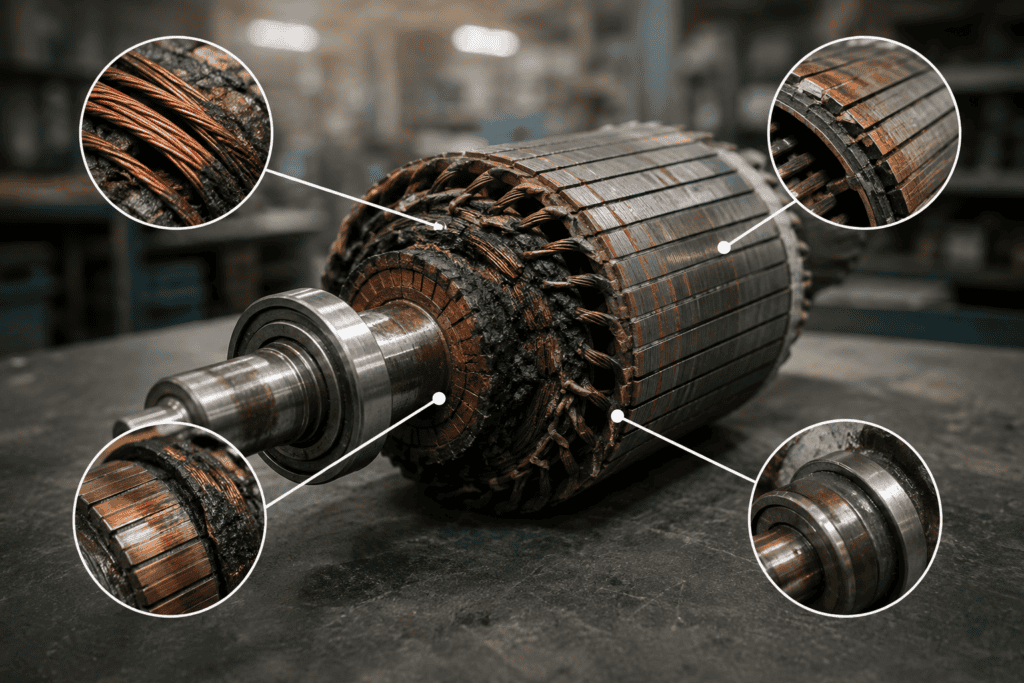
Summary: Motor rotor faults differ significantly from stator faults – they are more mechanical rather than electrical in origin. The three most common rotor problems are: end-winding throw-out in wound rotors; localized or widespread overheating in cast-aluminum rotors caused by broken or undersized bars from poor casting; and end-ring deformation, particularly in 2-pole high-speed motors.
Introduction
In motor fault cases, problems in the stator are mostly concentrated in the windings. Rotor problems, on the other hand, tend to be more mechanical in nature. For wound rotors, winding faults are of course also a concern. Compared to wound-rotor motors, cast aluminum rotors are far less likely to develop problems – but when they do, the issues tend to be serious.
End-Winding Throw-Out in Wound Rotors
Wound rotors carry copper windings in the rotor slots, with the winding ends projecting axially beyond the rotor core – these are the end windings. When a motor runs above its rated speed without overspeed protection, the centrifugal force acting on these end windings increases with the square of rotational speed. Beyond a critical threshold, this force overcomes the mechanical restraint of the banding or retaining structure, causing the end windings to deform radially outward – a condition commonly called “end-winding throw-out” or “coil-throwing”.
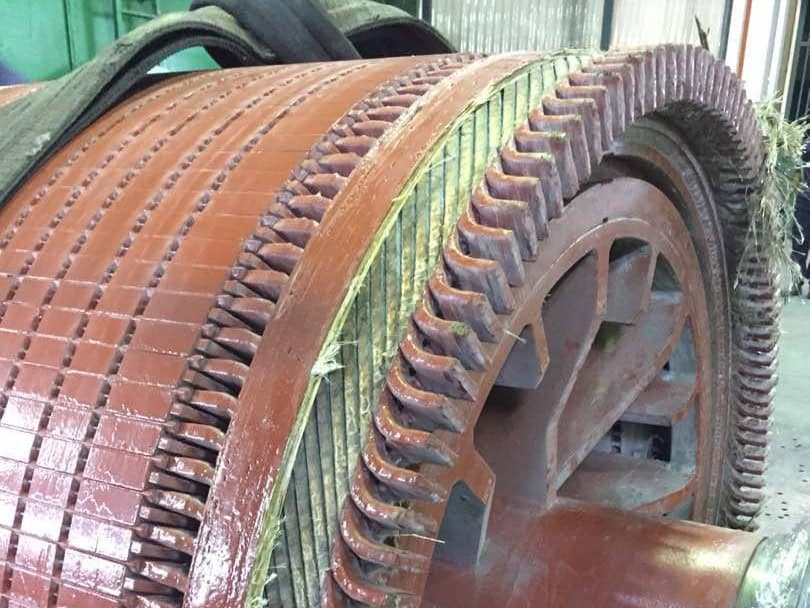
For this reason, wound-rotor motors are inherently speed-limited. Their synchronous speed is generally kept at 1,500 RPM or below (corresponding to 4-pole), and overspeed protection is essential whenever variable-speed operation is involved.
Rotor Bar Defects or Localized Overheating in Cast-Aluminum Rotors
In a squirrel-cage induction motor, there are a set of conductive bars embedded in the rotor slots, all short-circuited at each end by aluminum end-rings. In a cast aluminum rotor, both the bars and the end rings are formed in a single pressure-casting operation, injecting molten aluminum into the rotor lamination stack.
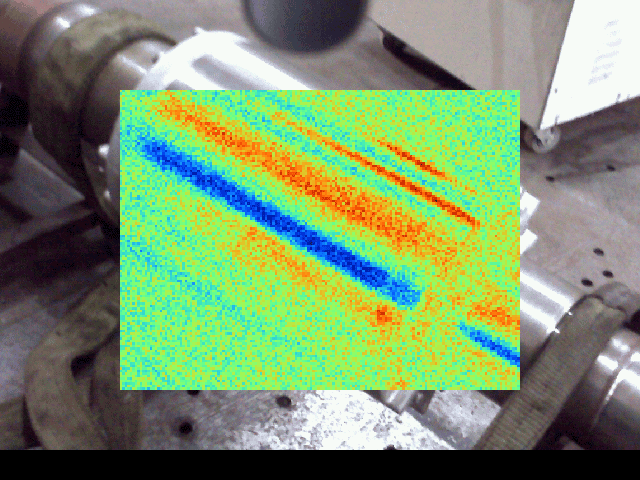
If the casting process is poorly controlled, the result can be broken bars (i.e. voids or cracks that interrupt current flow) or undersized bars (i.e. bars with reduced cross-sectional area). Either defect forces the remaining intact bars to carry more than rated current, causing localized overheating.
End-Ring Deformation in Cast-Aluminum Rotors
In cast aluminum rotors, the end-rings (and often integrated cooling fan blades), are cast as a single aluminum structure at each end of the rotor. Under normal operating conditions, these end sections are mechanically stable. However, under elevated thermal and electrical stress, a serious problem can occur.
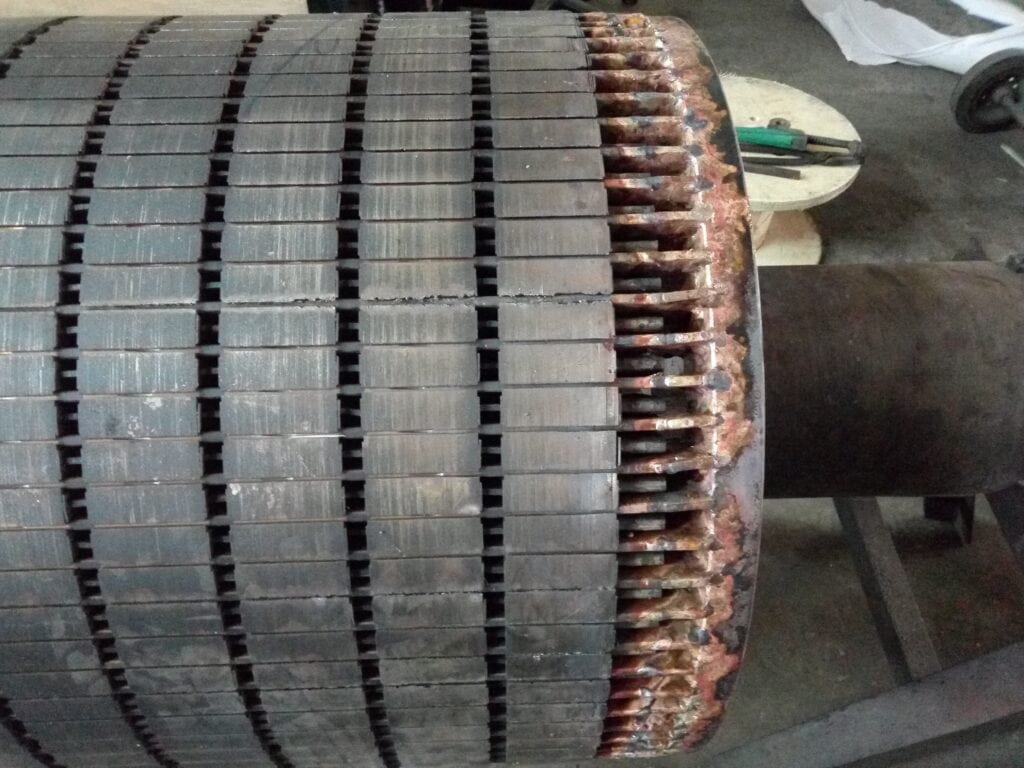
At high rotational speeds, centrifugal force acting on the end-ring mass can cause the aluminum to deform radially outward This is most pronounced in 2-pole motors, which run significantly faster than 4-pole machines. The susceptibility of the end structure is further compounded by the quality and density of the aluminum casting at the end-ring positions.
Key Takeaways: Perspective on Rotor Assessment
- The rotor, unlike the stationary stator, is subject to continuous mechanical stress from rotation as well as the electrical stresses of induced current.
- Rotor failures rarely have a single cause, they often arise from the interaction of mechanical design, electrical loading, and manufacturing quality.
- Any rotor fault investigation should therefore address both mechanical and electrical issues independently, and where necessary, include physical performance testing to verify that the rotor meets its design intent under representative operating conditions.