AC and DC, LV and HV motors up to 11 kV and 4,200+ kW. EASA AR100-2020 & IEC 60034 compliant. ISO 9001:2015 certified.
For large and medium-voltage motors, rewinding is almost always faster and more cost-effective than sourcing a replacement, especially when OEM lead times run months. When performed to EASA AR100-2020 and IEC 60034 standards, efficiency is maintained or improved, and the motor returns to service with full documentation.

Our rewinding procedures are performed in accordance with EASA AR100-2020 and IEC 60034 standards. Such a process typically involves the following steps:
Insulation resistance (5 kV for stator, 1 kV for rotor), surge voltage comparison, DC resistance, dimensional checks, and root-cause analysis before any work begins.
Removal of damaged windings and preparation of the stator core for new coil insertion. Dry-ice blasting and washing bay used for thorough decontamination.
Precision-formed coils manufactured to exact winding data. For MV motors, imported form-wound coils with custom slot wedges are used to maintain the original electromagnetic design.
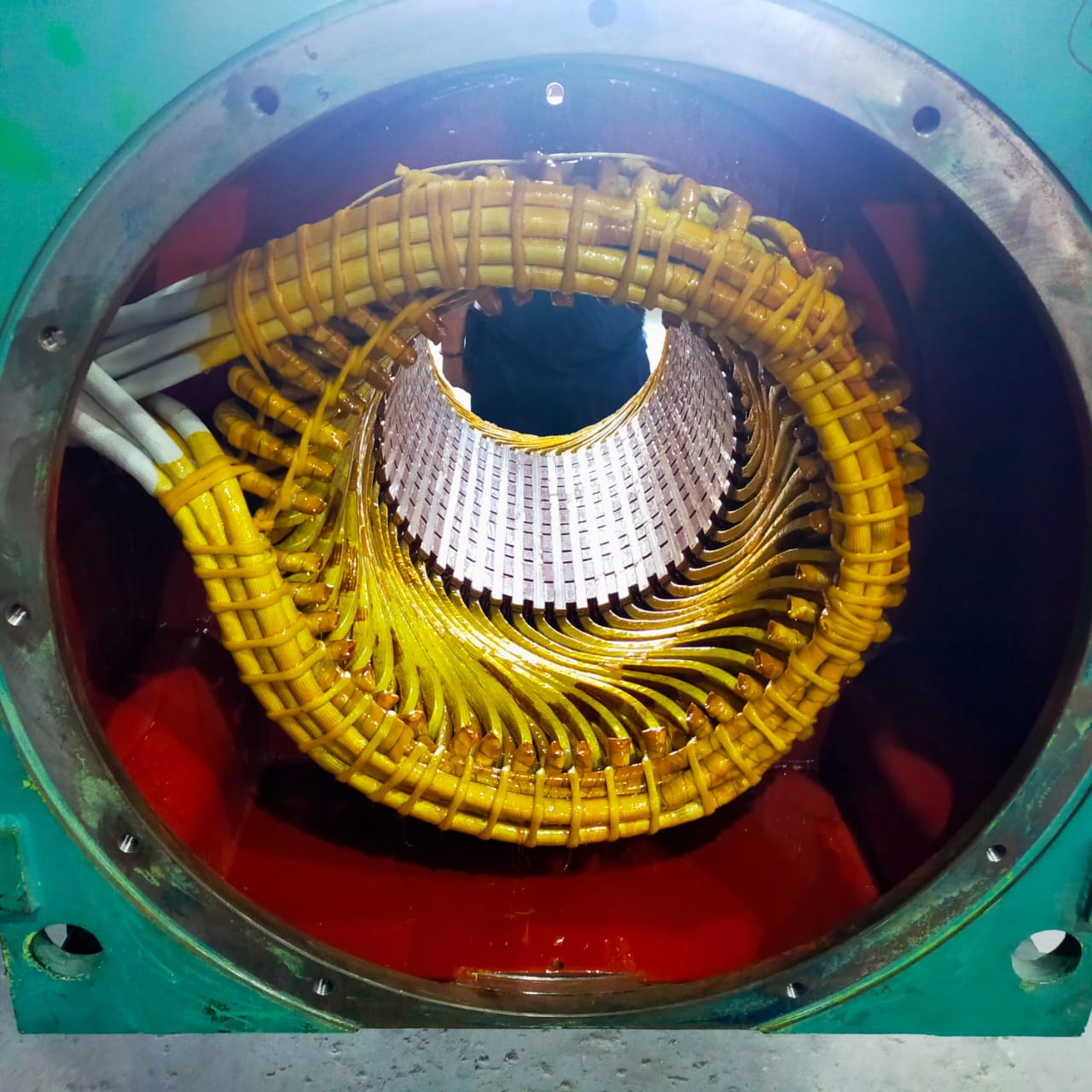
Winding insertion, connection, and resin impregnation. For 6.6 kV and 11 kV motors, resin-rich coils are used for superior dielectric performance.
Oven curing in temperature-controlled electric ovens for long-term insulation durability. Lathe machining and metal spraying ensure correct clearances on all bearing surfaces and shaft journals.
Surge comparison, insulation resistance, DC resistance, hi-pot, dynamic balancing to ISO 1940, and witnessed no-load test (vibration, bearing temperature, current balance) results are all documented in a formal service report.
Paint to original colour, wrapping, and preparation for reinstallation. Our team can assist with on-site commissioning and laser shaft alignment.
Rewind of a High Voltage motor with resin-rich coils
Rewind of DC motor stator
Rewind of a chiller motor with soft coils
Rewind of a submersible pump motor
It depends on motor size, damage severity, and coil availability. Simple LV service jobs can be completed in days; complex MV rewinding requiring imported form-wound coils typically takes 6–14 weeks. Contact us with your motor nameplate data for a realistic schedule estimate.
No — when performed to EASA AR100-2020 and IEC 60034 standards, efficiency is maintained and often improved. Our process uses matched copper cross-section, correct slot fill, and oven-cured impregnation to ensure no degradation. We verify this through post-rewind no-load current and PI (Polarisation Index) testing.
Every motor undergoes insulation resistance (1-minute and 10-minute PI), DC resistance across all phases, surge voltage comparison, dynamic balancing to ISO 1940, and a witnessed no-load test measuring vibration, bearing temperature, and current balance. HV motors also receive a hi-pot test. All results are documented in a formal service report.
Yes, we provide a standard warranty covering workmanship and materials supplied by GEF. Please contact us for specific warranty terms relevant to your motor type and application.