
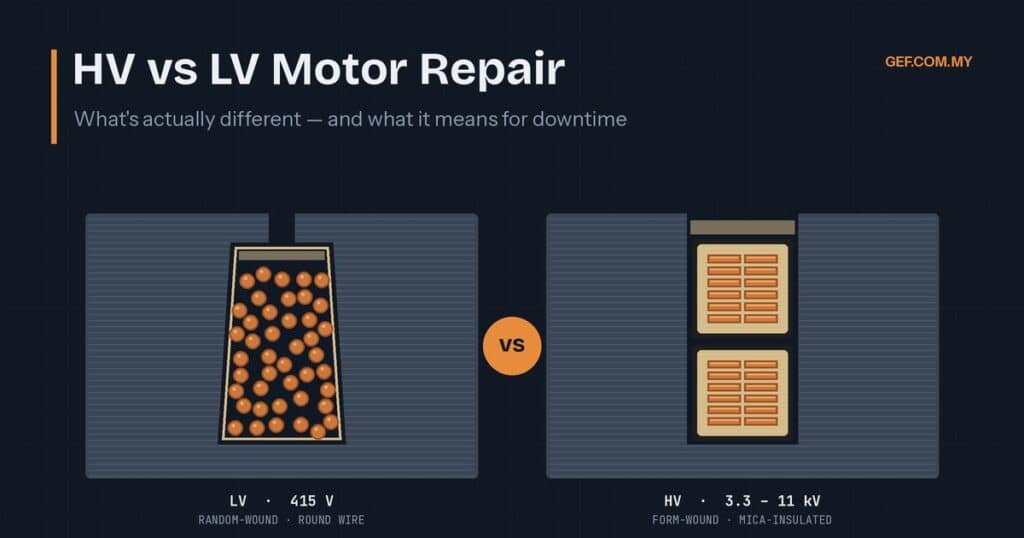
When a motor goes down, most plant teams ask the same two questions: how much and how long? The answers change dramatically depending on whether the machine on your floor is a low voltage motor or a high voltage one — and the gap is much wider than the voltage rating suggests.
Here is what actually changes, and what it means for your budget and your shutdown planning.
Where the line sits
In practice, Malaysian industry splits motors like this:
- Low voltage (LV) — up to 1,000 V, and overwhelmingly 415 V in local plants. Think pumps, fans, conveyors, compressors, agitators. Frame sizes are manageable, and there are usually several on site doing similar jobs.
- High voltage (HV) — typically 3.3 kV, 6.6 kV or 11 kV. These are the big ones: boiler feed pumps, main mill drives, large compressors, ID and FD fans. Often there is only one, and when it stops, the line stops.
That last point matters more than the voltage. LV motor repair is usually a maintenance event. HV motor repair is a production event.
The winding is a different product
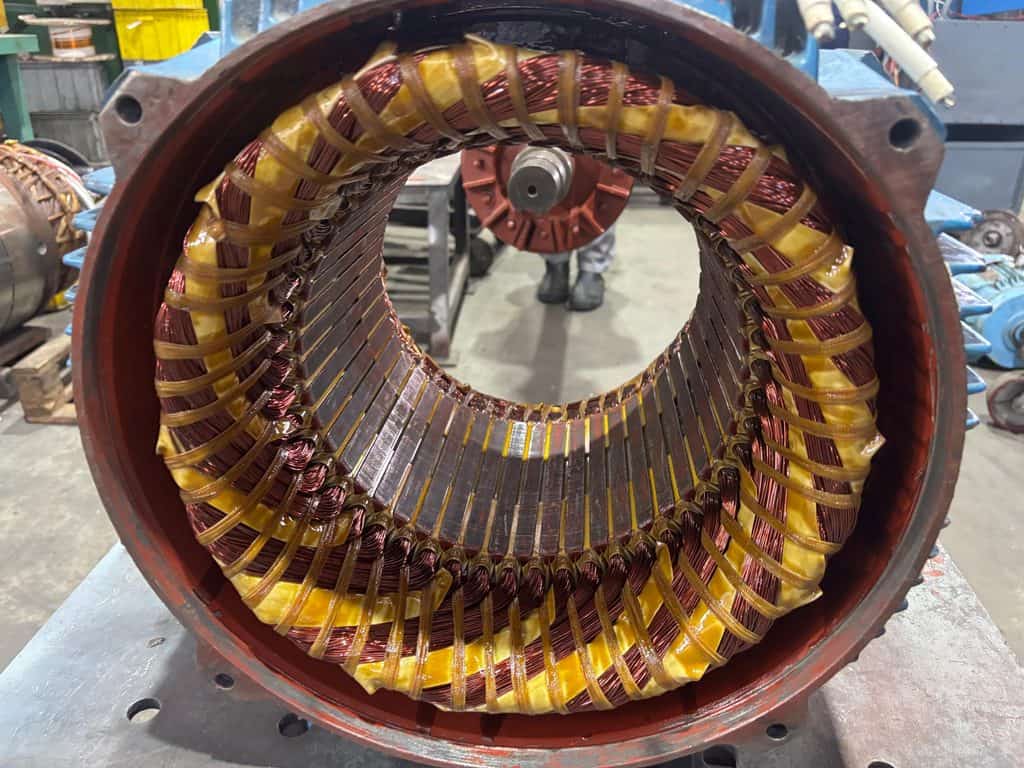
An LV stator is wound with round enameled copper wire pushed into the slots — what the industry calls a random-wound winding. The wire is a stock item, the winding is made in the workshop, and the insulation is finished by dipping and baking in varnish.
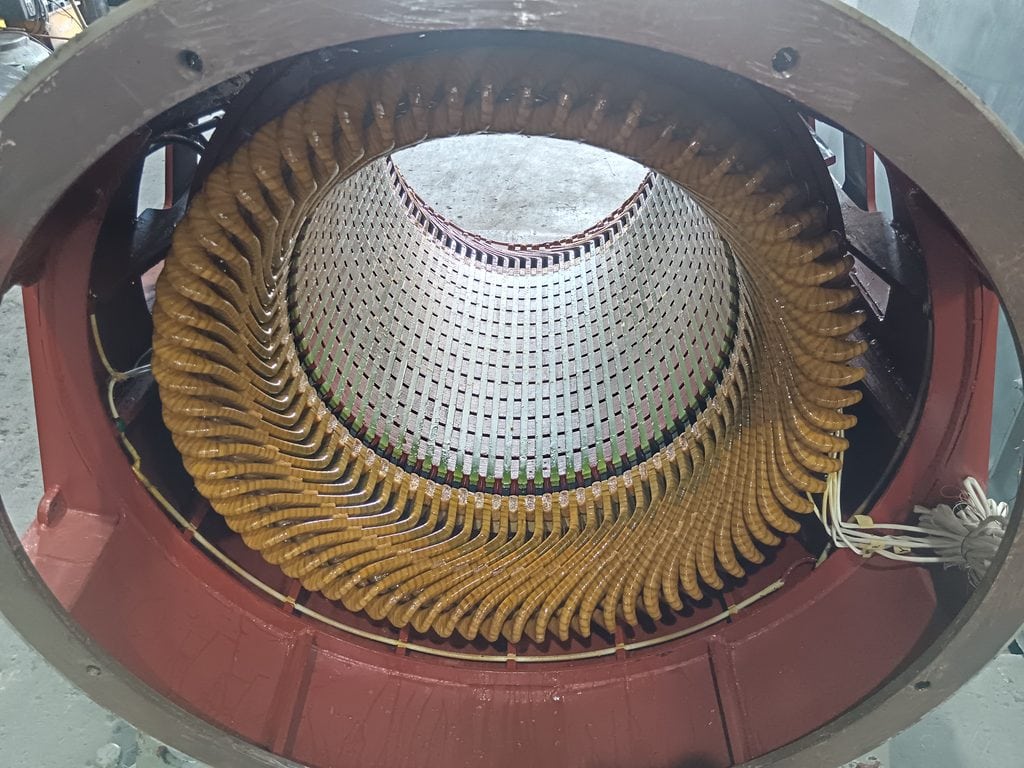
An HV stator uses form-wound coils: rectangular copper conductors, taped with mica-based insulation, pressed into a fixed shape before they ever go near the core. On top of that sit two layers most people never see — a semi-conductive slot armor and a stress grading tape at the slot exit, whose only job is to stop partial discharge quietly eroding the insulation from the inside. These coils are made to the specific machine. They are usually manufactured to order, and everyone has to be identical. That single fact is the origin of most of the cost and most of the lead time difference between an LV and an HV repair.
Testing is a different standard
An LV rewind is signed off with insulation resistance, a surge comparison test, a high-potential test and a run test.
An HV rewind adds a layer of diagnostics that exist because the failure modes are different. Good workshops also test individual coils before they go into the core, because finding a bad coil after wedging and connecting is an expensive way to learn.
The workshop has to be built for it
For LV work, most competent shops are adequately equipped. For HV, ask specifically about:
- Coil manufacturing — in-house or bought in, and from whom
- Oven capacity — can they take your frame size?
- Crane capacity and floor space — an 11 kV machine is not something you improvise around
- Documented test reports — issued as a matter of course, not on request
What it means commercially
| LV motor repair | HV motor repair | |
|---|---|---|
| Winding | Random-wound, stock wire | Form-wound coils, made to order |
| Insulation | Varnish or VPI | Mica tape, stress grading, VPI or resin-rich |
| Testing | IR, surge, hipot, run test | Coil-level testing |
| Typical turnaround | Days to a couple of weeks | Several weeks, driven by coil manufacture |
| Spare strategy | Often a shelf spare | Rarely a spare — repair is the plan |
| Failure impact | Localised | Usually a line or plant stoppage |
The practical consequences for planning:
For LV motors, replacement is a real option. New LV motors are readily available, and below a certain frame size a rewind may not make economic sense.
For HV motors, repair is usually the only realistic option. A new HV machine is a long-lead capital item, frequently six to twelve months, sometimes longer for a non-standard build. Waiting for one is rarely something a plant can absorb, which is why a well-executed rewind is not the cheap route — it is the fast route.
The takeaway
LV and HV motor repair share a name and very little else. One is a routine workshop job with a competitive supply market. The other is a specialised engineering exercise where the choice of repairer determines how long your plant is down and how long the repair lasts.
Judge them by different criteria — and choose the HV partner before you need one.
GEF Technologies has been rewinding and overhauling AC and DC motors for Malaysian industry from our Sungai Buloh facility, across both low and high voltage machines. If you’d like to discuss a repair, an assessment, or what a planned HV overhaul would involve, get in touch.