
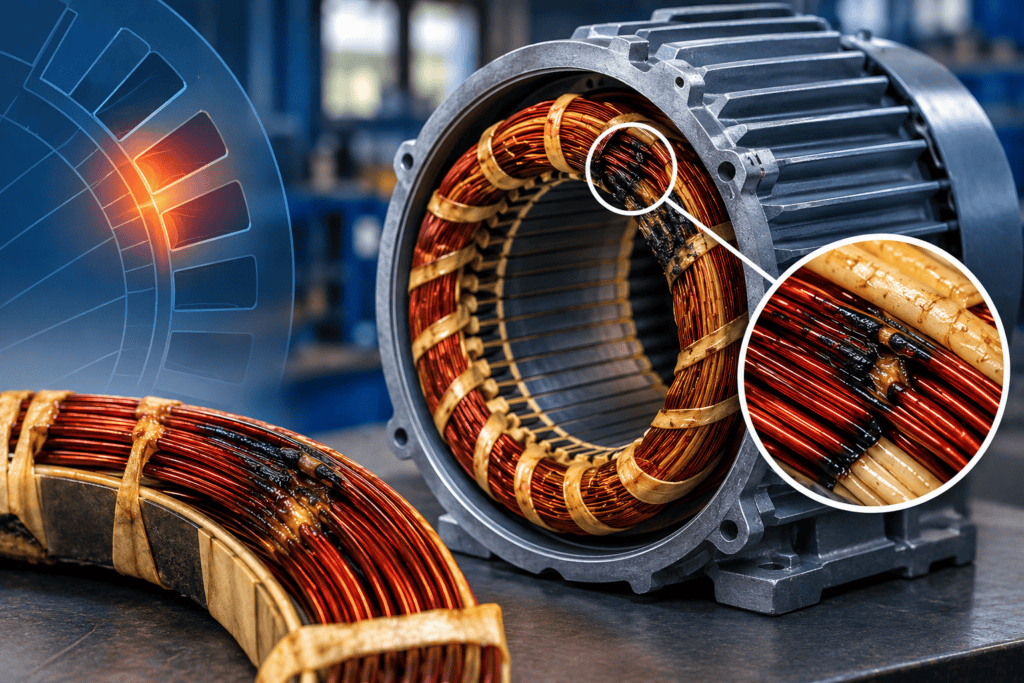
Inter-turn insulation failure, a short circuit between two adjacent turns of the same coil, is one of the most common ways an electric motor winding burns out. It rarely announces itself and the fault often begins as a pinhole of damaged enamel deep inside a slot, drawing a circulating current that heats the surrounding copper, and cascading into a full winding failure over days or weeks. By the time the motor trips, the coil is already scrap.
For motors driven by variable frequency drives (VFDs), the risk is significantly higher, and it concentrates in a very specific place: the first turn of the first coil.
Possible Causes of Inter-turn insulation Breakdown
When a motor winding’s end turns are not tightly secured, or the impregnation varnish treatment is poor, the insulating varnish does not bond firmly. During operation, under electromagnetic forces the inter-turn insulation rubs against itself, producing cracks and localised damage to the conductors’ outer insulation. This readily causes inter-turn breakdown between two or more adjacent magnet wires in the end-winding coils.
If the conductors are laid unevenly in the slot during coil insertion, or the insulating varnish fails to fully fill the spaces between the spaces between turns during impregnation, the inter-turn insulation inside the winding is prone to breakdown. During winding installation, if the slot fill factor of the stator core slots is too high, the conductors are forced into the slots during insertion and the magnet-wire insulation is damaged; once energised and running, impulse voltage then causes inter-turn insulation breakdown.
When a winding has many parallel branches. the inter-turn voltage within the slot rises, and during motor starting or forward/reverse operation the resulting overvoltage breaks down the coil’s inter-turn insulation. If the reinforced insulation protection on the first turn of a VFD motor coil is inadequate, overvoltage causes an uneven inter-turn voltage distribution across the winding, leading to inter-turn breakdown. A winding-to-ground or phase-to-phase breakdown short-circuit fault can likewise cause coil inter-turn insulation breakdown.
During the winding, insertion, shaping, and varnishing operations, the enamel film of the magnet wire can be scratched or knocked; when the connection joints are soldered, welding slag can drop into the winding and then be compressed during end-turn shaping.
Prolonged overheating, localised corona discharge under VFD operation, moisture and dust corrosion can also all make the inter-turn insulation brittle and carbonised, triggering an inter-turn short-circuit faults.
Lastly, when the stator core is press-fitted during motor assembly, misalignment between the core and the housing prevents uniform force distribution, causing localised excessive deformation of the stator. The winding coils are then squeezed and deformed, damaging the insulation layer between coils and creating a latent inter-turn short-circuit. In service, the winding insulation is subjected to this stress and the coils burn out.
Estimation of inter-turn voltage
Under rated conditions and normal power-frequency operation, a low voltage motor winding’s inter-turn voltage is governed mainly by the connection method. In a delta connection, each phase winding withstands 415 V; in a star (Y) connection the phase voltage is 240 V. The voltage is distributed evenly across all turns in proportion to the total turn count, so the inter-turn voltage is relatively low and stable.
At the instant of motor starting or VFD operation, however, the low voltage motor inter-turn insulation faces a severe test. Using a VFD, the peak voltage can reach 1000-1100 V, and the pulse concentrates near the winding’s first turn, reaching 700-900 V. This readily stresses the winding’s inter-turn insulation and burns out the first-turn coil.
How GEF can help
At GEF Technologies, we rewind and repair motors to withstand exactly these stresses — VFD-rated materials, reinforced first-turn insulation, controlled slot fill, and full impregnation, backed by proper testing before the motor goes back to work. If you run motors on variable frequency drives and want to avoid the cost and downtime of a burnt-out winding, talk to us about a condition assessment or a VFD-ready rewind.